
For years, the phrase “due diligence” in the Hong Kong IPO market was synonymous with a massive administrative exercise. It was often a frantic race to collect signatures, verify birthdates, and compile endless expert reports into a 500-page prospectus.
As of early 2026, the regulators have sent a clear message. The era of the check-the-box IPO is officially over.
For Sponsors and their legal teams, the stakes have shifted from administrative accuracy to substantive truth. If your diligence process relies solely on what can be found in a database or what an issuer tells you, your application is at risk of being more than just delayed. It is at risk of being returned.
The Regulatory Shift: Analyzing the January 2026 SFC Circular on Substantive Due Diligence
In January 2026, the Securities and Futures Commission (SFC) issued a landmark Circular that sent ripples through the investment banking community. The core directive is a mandate for Critical Assessment.
The SFC noted a troubling trend where Sponsors were increasingly acting as conduits rather than gatekeepers. They were commissioning third party reports on everything from Mainland China operations to cybersecurity and then simply plugging those findings into the prospectus without questioning the methodology or the gaps.
Key takeaways from the Circular include:
The Non-Delegation Rule: While Sponsors can hire experts like investigative firms, they cannot delegate their responsibility for critical judgment. If an expert report is flawed, the Sponsor remains legally and professionally liable.
Verification of Red Flags: Regulators now expect Sponsors to identify and investigate anomalies in an issuer’s history. This applies even if those anomalies were not part of the initial standard scope of work.
Professional Skepticism: The SFC is looking for evidence that the Sponsor pushed back on the issuer’s narrative rather than simply documenting it.
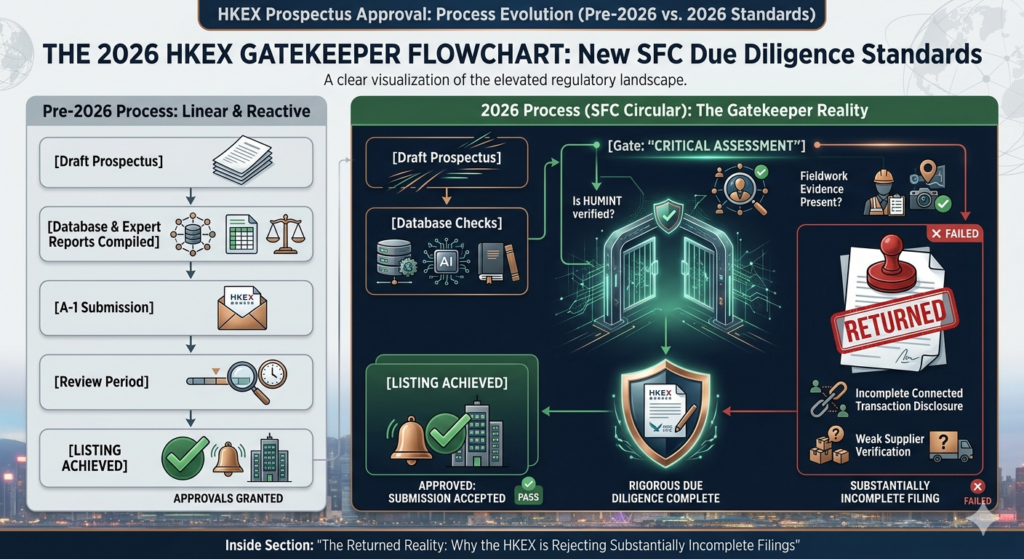
The Returned Reality: Why the HKEX is Rejecting Substantially Incomplete Filings at Record Rates
The HKEX has mirrored the toughness of the SFC. Throughout the first quarter of 2026, there has been a significant uptick in Return notices for A-1 filings. The primary reason is that filings were deemed Substantially Incomplete.
In the past, incomplete might have meant a missing signature or an outdated financial table. Today, incompletely refers to disclosure quality. If a prospectus describes a complex corporate structure or a connected transaction but fails to provide a substantive explanation of the underlying risks, the Exchange is now empowered to send it back immediately.
This returned reality is a nightmare for issuers. A returned application is a public signal of poor governance, often leading to specific consequences:
Massive Reputational Damage: The market sees the return, and investor confidence evaporates before the roadshow even begins.
Increased Regulatory Scrutiny: Once an application is returned, every subsequent filing is viewed through a much sharper lens.
Lapsed Timelines: In a volatile market, a two-month delay can mean missing a crucial valuation window.
From Process to Substance: Moving Beyond Automated Reports to Critical Assessment
So, how do Sponsors move from Process (checking a list) to Substance (verifying the reality)? It starts by acknowledging that a database search is not a shield.
Many global tech platforms offer automated background checks that are excellent for high-volume, low-risk screening. However, they are fundamentally ill-equipped for the complexities of a 2026 Hong Kong listing. This is particularly true for businesses with deep ties to Mainland China or those operating in the Chapter 18C specialist tech sector.

The Critical Assessment Standard
To meet the new standard, a diligence program must include three specific investigative layers:
1. Beyond the Public Record (HUMINT) Database hits are only as good as the registries they pull from. Substantive diligence requires human intelligence. This means speaking to former employees, competitors, and industry insiders to verify a director’s reputation or a company’s market standing.
2. Targeted Fieldwork If an issuer claims a massive manufacturing footprint in a Tier 3 city, a site visit by a local lawyer is not enough. You need investigators who can conduct boots on the ground verification to ensure the factory is not a shadow operation designed to inflate assets.
3. Digital and Crypto Forensics For the growing number of Fintech and Web3 listings, substance means verifying on-chain asset provenance. You cannot check a box for a crypto wallet. You must trace the funds to ensure they are not linked to sanctioned entities or money laundering.
The Bottom Line: Protecting the Concerned Sponsor
In 2026, the role of the Sponsor Principal is more precarious than ever. With the SFC increasingly naming individual Concerned Sponsors in disciplinary actions, the goal of due diligence has shifted from completing the file to building a defensive record.
At Sphere State Group, we do not just provide reports. We provide the critical assessment that regulators demand. We help you identify the red flags before the SFC does, ensuring that when you hit submit on that A-1 filing, you are not just crossing your fingers. You are standing on solid ground.
Is your diligence process ready for a 2026 SFC inspection? Let’s ensure your next listing is not just a process, but a success.